
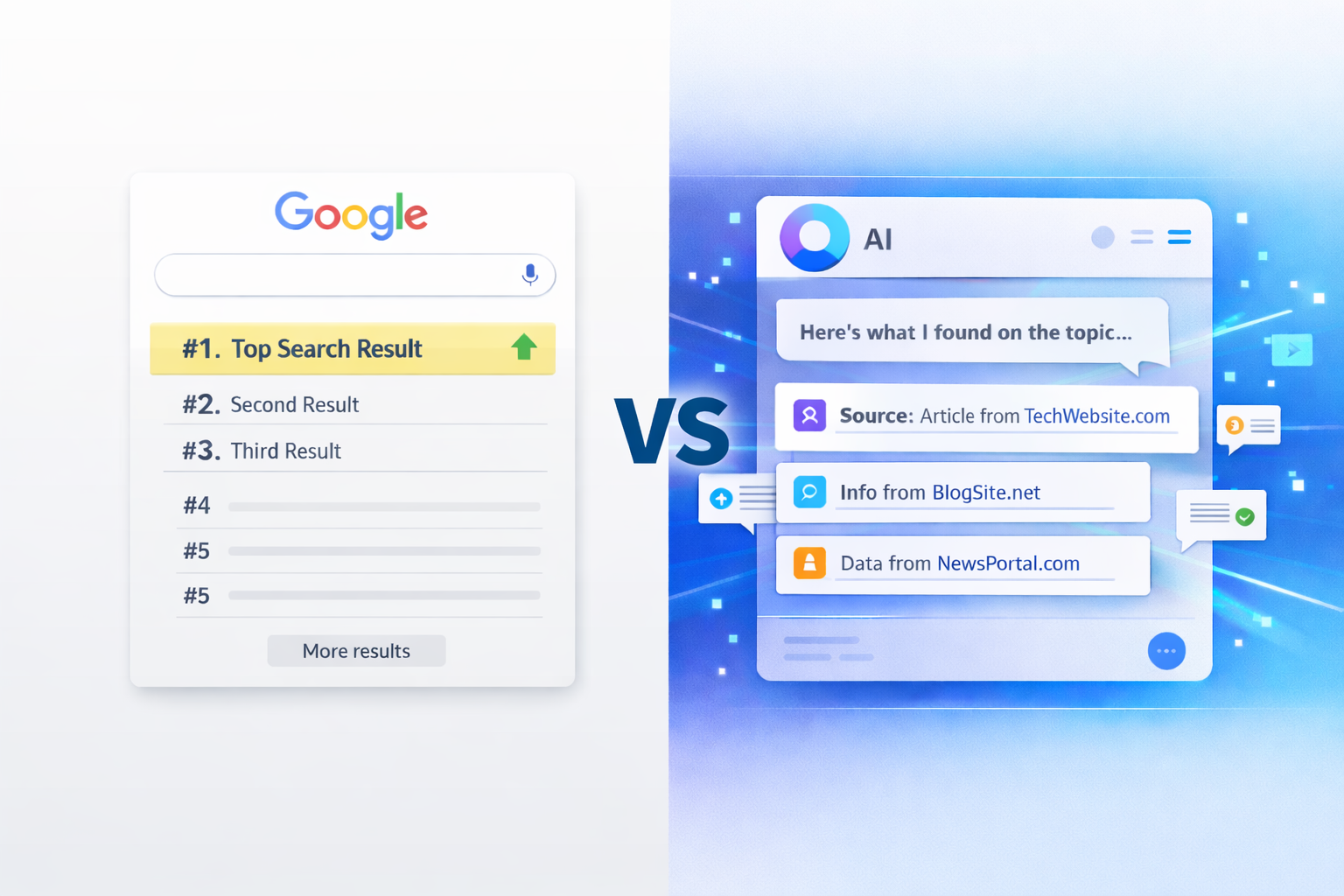
The New Battle Is Getting Cited by AI
For nearly two decades, digital marketing teams chased one objective: ranking #1 on Google.
Entire industries were built around this goal. SEO strategies, backlink campaigns, content farms, and technical optimization all revolved around the same metric—visibility on the search results page.
But in the past 9–12 months, something fundamental has changed.
Search engines are no longer simply directing users to websites.
Instead, they are answering the question themselves.
Google’s AI Overviews, along with AI-powered search experiences from tools like ChatGPT, Gemini, and Perplexity, are reshaping how users interact with information online.
And the implication for marketers is massive.
Ranking #1 is no longer the finish line.
Now the real question is:
Will AI mention your brand when it answers the question?
The Rise of AI Overviews: A New Wall Between You and Your Traffic
Google’s introduction of AI Overviews fundamentally changes the user journey.
Previously, a user would:
- Search a question
- See a list of links
- Click a website to get the answer
Today, the experience often looks like this:
- Search a question
- Read an AI-generated summary immediately
- Only sometimes click a source link
This creates a new barrier between your content and the visitor.
Your article might still rank well…
But if the user gets the answer from the AI summary, they may never visit your website.
This means organic traffic is no longer controlled solely by rankings.
Instead, AI-generated answers are acting as a filter layer between searchers and publishers.
From Ranking Pages → To Being Cited by AI
This shift introduces a new form of visibility.
Instead of fighting only for position #1, marketers are now fighting for something else:
Citation.
When an AI overview generates an answer, it often references sources. These citations are the new form of authority signals.
Being cited inside AI-generated answers means:
- Your brand is associated with expertise
- Your content becomes part of the AI’s knowledge base
- Your authority compounds over time
- Your visibility appears before users even click anything
In other words:
Being cited beats being clicked.
Because citations influence thousands of AI-generated answers, not just one search query.
SEO Has Quietly Changed in the Last 9 Months
While many businesses still follow traditional SEO playbooks, the landscape has already shifted.
Some of the biggest changes include:
1. Search Results Are Becoming Answer Engines
Google is evolving from a search engine into an answer engine.
Users now receive summarized answers directly on the results page.
2. Clicks Are Declining for Informational Queries
For many informational searches, users never click a website at all.
They simply read the AI overview.
This is creating a measurable increase in zero-click searches.
3. Authority Signals Matter More Than Keywords
AI models rely heavily on entity recognition and authority signals, not just keyword density.
Brands, authors, organizations, and structured knowledge are now critical.
4. Featured Snippets Are Becoming AI Training Signals
Content that wins featured snippets, structured answers, and FAQ formats is more likely to be used by AI systems.
This means formatting and clarity now influence discoverability.
5. SEO Is Expanding Into GEO (Generative Engine Optimization)
A new discipline is emerging.
GEO — Generative Engine Optimization.
Instead of optimizing pages only for search engines, marketers must now optimize content so AI systems understand and cite it.
The New Visibility Strategy: AI Citation
The future of organic visibility will likely be defined by three layers:
1️⃣ Traditional search rankings
2️⃣ Featured snippets and structured answers
3️⃣ AI-generated citations
The brands that win the third layer will dominate the next decade of organic discovery.
5 Things Businesses Should Start Doing Now
If your SEO strategy hasn’t evolved yet, now is the time.
Here are five practical steps businesses should begin implementing immediately.
1. Write for Entities, Not Just Keywords
Traditional SEO focused on phrases and keywords.
AI systems, however, rely on entities.
Entities include:
- brands
- organizations
- products
- locations
- authors
- recognized topics
Instead of writing “best digital marketing strategy,” AI prefers content that connects recognized entities and concepts together.
Your brand must appear in a knowledge context, not just keyword placement.
2. Structure Content for Answers
AI prefers content that clearly answers questions.
Pages that contain:
- concise explanations
- structured headers
- FAQ sections
- step-by-step lists
- definition blocks
are significantly easier for AI to summarize and cite.
Think of your content as training material for AI models.
3. Strengthen Topical Authority
AI systems look for clusters of expertise.
Publishing one article on a topic is no longer enough.
Instead, build topic ecosystems, where multiple articles reinforce authority around a subject.
For example:
Instead of one article about SEO, create a cluster covering:
- AI search changes
- entity-based SEO
- generative search
- structured content optimization
- AI citation strategies
Authority emerges through depth and coverage.
4. Earn High-Trust Mentions Across the Web
AI models rely heavily on trusted sources across the internet.
This includes:
- reputable blogs
- industry publications
- Wikipedia-style knowledge bases
- Reddit discussions
- academic or industry reports
The more often your brand appears in trusted environments, the more likely AI systems will recognize it as authoritative.
5. Optimize for Featured Snippets
Featured snippets remain one of the strongest AI extraction signals.
If your content consistently wins snippets, you dramatically increase the chance of being used in AI summaries.
This means structuring content with:
- direct answers
- numbered lists
- concise definitions
- tables and comparisons
These formats are extremely easy for AI to interpret.
The Bottom Line
For years, the SEO conversation was simple.
“How do we rank higher?”
Now the question has evolved.
“How do we become the source AI trusts?”
Visibility is shifting from search rankings to AI citations.
The businesses that adapt early will gain a powerful advantage in the new search ecosystem.
The ones that don’t may find their traffic slowly disappearing behind AI-generated summaries.
Want to Understand What This Means for Your Business?
This shift is happening quickly, and most businesses haven’t adjusted their strategy yet.
If you’re curious about:
- whether AI systems already recognize your brand
- how your content performs inside AI summaries
- what steps you should take next
we’re happy to walk you through it.
Schedule a discovery call with our team, and we’ll show you how to position your brand for the next generation of search.
👉 Book a strategy call and let’s explore where your visibility stands in the AI search era.