

Picture two marketing managers. Same industry. Same budget. Same pressure from leadership to “do something with AI.”
The first one downloaded three AI tools in January. By March, the team had stopped using two of them. The third gets opened occasionally, mostly for first drafts that end up being rewritten anyway. When asked how AI is working for them, the honest answer is: “we’re using it, sort of.”
The second one spent February mapping their highest-volume, most repetitive marketing tasks. By March, they had one AI workflow running consistently — their weekly content pipeline — cutting production time by 60%. By May, they had three workflows embedded. The team does not think of AI as a tool anymore. It is just how they work. Our digital marketing consulting services
According to Supermetrics’ 2026 Marketing Data Report, 80% of marketers feel pressure to adopt AI — but only 6% have fully embedded it into their workflows. The gap between those two numbers is not a technology problem. It is a strategy problem.
Here is what separates the 6% from the 94%, and how to cross that line without overhauling everything at once.
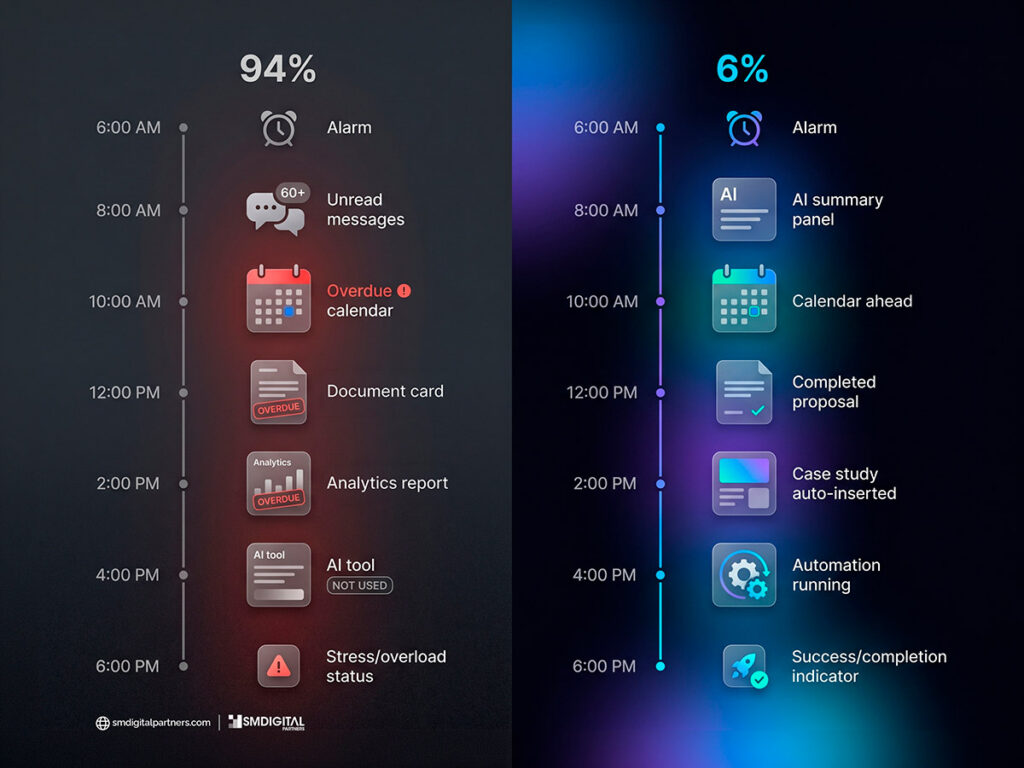
A Day in the Life: The 94% vs. The 6%
The marketer stuck in the 94%
The alarm goes off. Before the first meeting, there are seventeen unread Slack messages about last week’s campaign performance. The content calendar is behind by four posts. Someone needs a proposal drafted by noon. The SEO report is overdue.
AI tools are installed on the laptop. They get opened when there is “time to experiment.” There is never time to experiment. The tools feel like homework — something to figure out eventually, once things calm down.
Things never calm down.
The marketer operating in the 6%
The alarm goes off. Before the first meeting, the AI-generated weekly performance summary is already in the inbox — pulled from the dashboard, analyzed, and formatted automatically. The content calendar is ahead by two weeks because the AI drafting workflow runs every Monday morning. Proposals take 25 minutes because there is a structured AI-assisted template that pulls in relevant case studies and adapts the tone to the prospect.
AI is not a project. It is infrastructure. It runs whether or not there is “time.”
Why Most Businesses Get Stuck
The most common failure mode is treating AI adoption like software procurement: buy the tool, give the team access, expect results. This approach works for project management software. It does not work for AI.
AI tools require workflow design — a deliberate decision about which task, which input, which output, which quality standard, and who is responsible for reviewing the result. Without that design, teams try the tool, get inconsistent output, lose confidence, and quietly stop using it.
The second most common failure mode is trying to transform everything at once. A team of four cannot rebuild their entire marketing operation around AI in a quarter. But they absolutely can embed one AI-powered workflow per month and compound that progress over time.
The 3-Step Entry Plan: How to Join the 6%
This is not generic ‘start small with AI’ advice. This is the specific sequence that produces durable adoption.
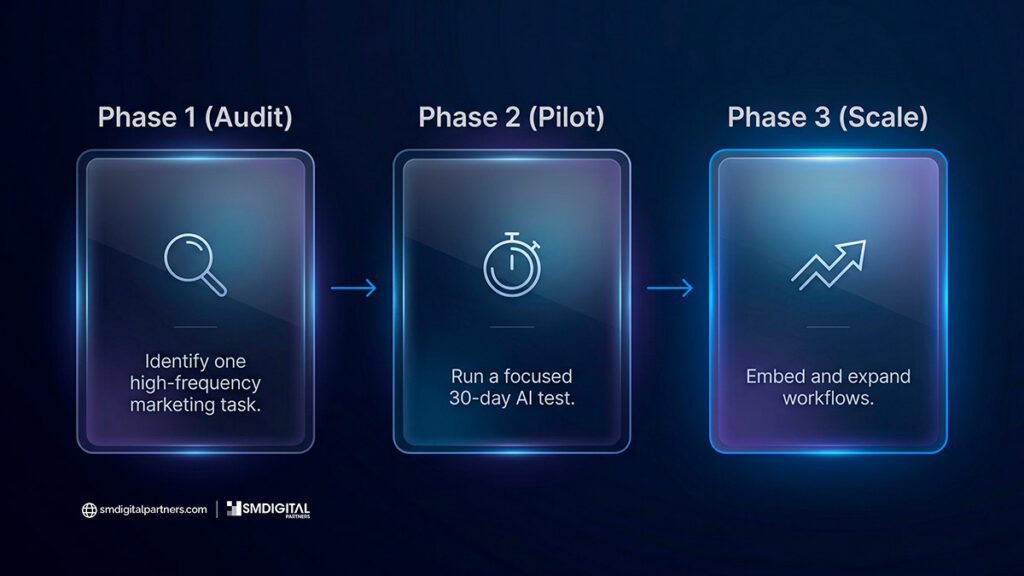
| 1 | Audit one high-frequency task. Identify the single marketing task your team does most often that follows a repeatable pattern — weekly reporting, social captions, email subject lines, campaign briefs, proposal drafts. It must be something done at least weekly, and something where the process is roughly the same every time. That is your entry point. Marketing automation |
| 2 | Run a 30-day single-tool pilot. Pick one AI tool that automates or accelerates that specific task — not the best AI tool in general, but the best tool for that task. Run it for 30 days. Measure three things: time saved per week, output quality vs. your previous standard, and team adoption rate (are people actually using it consistently?). Do not add a second tool until you have real numbers from the first. |
| 3 | Document and scale. At the end of 30 days, write down what changed. If time savings are real and quality holds, that workflow is now your baseline. Move to the next highest-frequency task and repeat. Within six months, you will have three to five embedded AI workflows. That is the 6%. |
The businesses that reach the 6% do not get there because they have better AI tools. They get there because they approached adoption as a process design challenge, not a technology procurement decision.
Which AI Tools Actually Belong in a Marketing Workflow
Not all AI tools are built for workflow integration. Below are the categories that deliver the most consistent ROI when embedded into regular marketing operations.
Content and copy
- Jasper AI — Long-form content drafting, campaign briefs, email sequences. Best when given a detailed prompt template your team refines over time.
- Copy.ai — Short-form copy: headlines, ad variations, social captions. Excellent for high-volume output tasks.
- Surfer SEO — AI-assisted content briefs grounded in keyword data. Reduces research time significantly for SEO-driven content.
Reporting and analytics
- Supermetrics — Pulls data from across platforms into a single reporting layer. Pairs with AI summarization tools to produce automated weekly summaries.
- Google Looker Studio + AI narrative tools — Turns dashboard data into written performance narratives without manual interpretation.
Campaign and audience management
- HubSpot AI — Lead scoring, email personalization, workflow automation. Most powerful when CRM data is clean and segmentation is already defined. Social media marketing
- Meta Advantage+ and Google Performance Max — Automated campaign optimization. Best used with clear conversion goals and sufficient historical data.
SEO and discoverability
- Semrush AI Writing Assistant — Real-time SEO guidance during content creation.
- Clearscope or MarketMuse — Topic modeling and content gap analysis. Reduces the guesswork in building topical authority. SEO strategy
The pattern across all of these: they work best when they are embedded into a defined process, not used ad hoc. The tool is not the strategy. The workflow is the strategy.
What SM Digital Partners Does Differently
When we work with a business on AI marketing implementation, the first thing we do is not recommend tools. The first thing we do is map their current workflows — what gets done, how often, by whom, and where the bottlenecks are.
From that map, we identify the two or three points where AI creates the most leverage for that specific business. Then we build the workflow, configure the tools, train the team, and measure the results. Human oversight is not optional — it is built into every process we design.
The 6% do not look the way they do because they found better software. They look the way they do because someone helped them design the system. Lead generation
Frequently Asked Questions
Most businesses are stuck because they approach AI as a tool to bolt on rather than a capability to build in. They try one tool, get inconsistent results, and abandon the effort. True AI implementation requires a workflow-first approach: identifying where AI creates the most leverage, then building repeatable processes around those specific points.
Full AI implementation means AI is embedded in how work actually gets done, not just available as an option. It means your team uses AI tools consistently, output is measured, and the results feed back into improving the process. According to Supermetrics, only 6% of marketers have reached this level in 2026.
Step 1: Audit one high-frequency marketing task that consumes time but follows a repeatable pattern. Step 2: Identify one AI tool that automates or accelerates that specific task and run a 30-day pilot. Step 3: Document what changed in output quality, speed, and cost — then use that data to decide the next workflow to transform.
For a small to mid-size team, meaningful adoption — two to three embedded AI workflows running consistently — typically takes three to six months. The timeline depends less on the tools and more on how clearly workflows are defined and how consistently the team uses them during the pilot phase.
Ready to Move from the 94% to the 6%?
Most businesses already have the tools. What they are missing is the system. At SM Digital Partners, we build that system — from workflow audit to tool configuration to ongoing optimization — with human oversight at every step.
If you’re ready to stop experimenting and start building, let’s talk. Schedule a free consultation
Also in this series: If you haven’t read about the personalization gap yet, start with The Personalization Gap. And to see the actual revenue impact of getting this right, read real AI marketing ROI numbers.